


Probiotics Powder
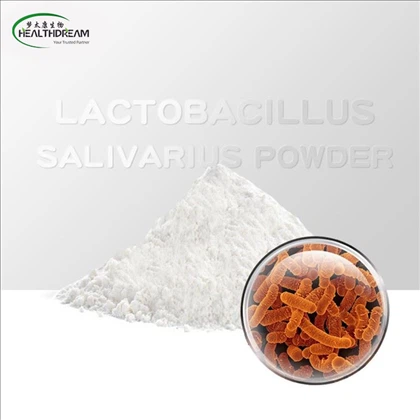
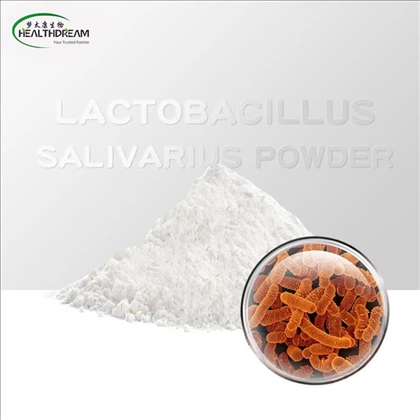






Lactobacillus salivarius powder
Lactobacillus salivarius is a probiotic naturally present in the oral cavity and intestinal tract. It is well-known for inhibiting bad breath-related pathogens and reducing volatile sulfur compound levels. Clinical studies confirm that specific strains su
Description


Can Lactobacillus salivarius improve bad breath?
Numerous clinical studies have confirmed that Lactobacillus salivarius significantly improves halitosis through multiple mechanisms.
1. Reduce Volatile Sulfur Compound (VSC) Levels
The primary cause of bad breath is volatile sulfur compounds (VSCs) produced when oral pathogenic bacteria break down sulfur-containing amino acids.Lactobacillus salivarius directly reduces VSC production by inhibiting periodontal pathogens including Porphyromonas gingivalis, Tannerella forsythia and Treponema denticola.In vitro studies show that strain WB21 significantly suppresses the growth of these three major periodontal pathogens at a concentration of 12.5% (P<0.05).
2. Clinically Proven Improvement in Halitosis
Multiple clinical trials verify the halitosis-relieving effects of Lactobacillus salivarius:
Strain WB21: In an open-label trial involving 20 patients with genuine halitosis, daily intake of 2.0×10⁹ CFU WB21 tablets for 4 weeks markedly improved halitosis indicators. Parameters for physiological bad breath dropped significantly after 2 weeks, while odor scores and gingival bleeding scores for pathological halitosis decreased notably after 4 weeks. In co-culture tests, VSC levels declined significantly (P<0.05) when WB21 was mixed with periodontal pathogens at a ratio of 1:1 or higher.
Strain CCFM1215: A double-blind randomized controlled trial published in 2024 further confirmed that Lactobacillus salivarius CCFM1215 greatly reduces VSC values and optimizes oral microbial composition to relieve halitosis.
Evidence supported by Meta-analysis: A systematic review and meta-analysis released in 2024 concluded that probiotics including Lactobacillus salivarius support oral health by lowering VSCs and improving saliva quality. Overall data prove probiotics are a safe adjunct solution for halitosis management.
3. Neutralize VSCs and Suppress Odor-Producing Bacteria
Lactobacillus salivarius not only restricts malodorous pathogens but also directly neutralizes existing VSCs. It targets the root cause of chronic bad breath instead of simply masking odors. Meanwhile, it reduces pro-inflammatory cytokines, lowers gingivitis risk and promotes overall oral wellness.

| Product Name: | Lactobacillus salivarius Powder |
| Strain name: | Lactobacillus salivarius |
| Strain identification: | Characteristic by API 50CH&16S rDNA |
| Type: | Freeze dried powder |
| Packing: | 1kg/bag, 5kg/bag in cold-chain package |
| Storage: | Package sealed at 4℃ or refrigeration - 18℃ |
| Shelf life: | 24 months from date of production |
| Certfication: | NSF, HACCP, ISO9001, Kosher, HALAL |
| Documents support: | Genetic identification report |
| IDA deposit certificate | |
| Certificate of analysis | |
| Stability study report | |
| Anti-bile salt & Anti gastro-acid study report | |
| Antibiotic sensitivity test certificate | |
| Safety study report | |
| Microbial Enumeration method |

| Descrption: | Fine powder, no caking, no abnormal odor, no visible foreign bod |
| Color: | White to light yellow |
| Mositure: | NMT 5.0% |
| Water activity: | < 0.12% |
| Viable cell count: | NLT 200 billion cfu/gram |
| Non LAB count: | < 5000 cfu/g |
| Yeast &mould: | NMT 50 cfu/g |
| Coliform: | < 10 cfu/g |
| Pathogenic bacteria: | Negative |
| Lead(Pb): | NMT 0.5 mg/kg |
| Arsenic(As): | NMT 0.5 mg/kg |
| Cadmium(Cd): | NMT 1.0 mg/kg |
| Mercury(Hg): | NMT 0.1 mg/kg |

1.Improve Halitosis & Oral Health
A double-blind RCT conducted in 2024 verified that strain CCFM1215 significantly reduces volatile sulfur compound (VSC) levels in people with bad breath, elevates beneficial oral bacteria (Lactobacillus, Bifidobacterium) and lowers periodontal pathogens (Fusobacterium, Porphyromonas). Strain WB21 inhibits the growth of major periodontal pathogens including Porphyromonas gingivalis. Meta-analysis confirms probiotics are a safe adjunct approach for halitosis management.
2. Regulate Gut Microbiota & Optimize Bowel Movements
Clinical trial of CECT5713 (40 adults, 2×10⁸ CFU daily for 4 weeks) showed remarkable growth in fecal Lactobacillus counts (P=0.001) and improved defecation frequency (P=0.04). Strain UCC118 features good intestinal transit and colonization capacity, modulates fecal microbiota and activates immune responses.
3. Enhance Immune Function
CECT5713 notably increases the proportions of NK cells and monocytes, and raises plasma levels of IgA, IgG, IgM and anti-inflammatory cytokine IL-10 (72.3 pg/mL in probiotic group vs 27.3 pg/mL in placebo group, P<0.01). Animal studies show it suppresses TNF-α production, elevates hepatic glutathione levels and delivers anti-inflammatory & antioxidant effects.
4. Anti-Inflammatory & Antioxidant Properties
In weaning piglet models, Lactobacillus salivarius alleviates LPS-induced inflammation and oxidative stress in a dose-dependent manner, and repairs intestinal barrier function. Its antibacterial metabolites including organic acids, peroxide and bacteriocins make it highly suitable for animal microecological preparations.

1. Highly Strain-Specific FunctionsDifferent strains possess distinctly targeted benefits: WB21 (halitosis relief, anti-periodontal pathogens), CCFM1215 (VSC reduction, oral microbiota regulation), CECT5713 (immune support, gut health), UCC118 (intestinal colonization, immune activation), C-1-3 (broad-spectrum antibacterial activity). Formulation development requires precise strain selection matching targeted health benefits.
2. Dual Colonization in Oral Cavity and IntestinesLactobacillus salivarius can colonize both the oral cavity and intestinal tract. In the mouth, it adheres efficiently to oral epithelial cells and suppresses the growth of periodontal pathogens. In the gut, strain UCC118 passes through the digestive tract smoothly, survives and persists in the ileum with excellent colonization performance. Human clinical trials also confirm that strain CECT5713 travels through the gastrointestinal tract intact and delivers stable probiotic effects.
3. Excellent Acid and Bile Salt ToleranceLactobacillus salivarius exhibits strong resistance to gastric acid and bile salts. Strain C-1-3 performs well in acid tolerance, bile salt tolerance and high-temperature resistance tests, and delivers powerful inhibition against Escherichia coli, Salmonella and Staphylococcus aureus. Strain MTC 1026 is identified as Gram-positive bacillus. It produces acid from multiple carbon sources including D-glucose, D-fructose, lactose, mannitol, sorbitol, inulin and starch, enabling stable survival in complex intestinal environments.
4. Strong Bacteriocin Production CapacityLactobacillus salivarius is a high-yield bacteriocin strain that synthesizes multiple bacteriocin subtypes, including Class IIa, IIb and IId. These bacteriocins feature broad-spectrum antibacterial effects, enhancing microbial competitiveness in gut ecology while directly inhibiting spoilage bacteria and pathogenic microbes. Combined with organic acids, peroxide and protein-based antibacterial substances, it boasts extensive application prospects in food biopreservation and microecological preparations.

Q1: What are the well-known strains of Lactobacillus salivarius and their respective functions?
A: WB21 (improves halitosis, inhibits periodontal pathogens); CCFM1215 (reduces VSC levels, optimizes oral microbial composition); CECT5713 (boosts immunity, increases NK cells and immunoglobulins, balances gut microbiota and improves bowel movements); UCC118 (intestinal colonization, immune activation); C-1-3 (broad-spectrum antibacterial activity against Escherichia coli, Salmonella and Staphylococcus aureus).
Q2: Can Lactobacillus salivarius improve bad breath?
A: Yes. A double-blind RCT in 2024 confirmed that strain CCFM1215 significantly lowers volatile sulfur compound levels in people with halitosis, reduces Fusobacterium nucleatum in gingival crevicular fluid, and raises beneficial oral bacteria abundance. Strain WB21 inhibits periodontal pathogens such as Porphyromonas gingivalis. Meta-analysis also proves probiotics are a safe adjunct solution for halitosis management.
Q3: Can Lactobacillus salivarius strengthen immune function?
A: Yes. RCT data of strain CECT5713 showed that after 4 weeks of supplementation, the proportions of NK cells and monocytes increased remarkably, alongside elevated plasma IgA, IgG, IgM and anti-inflammatory cytokine IL-10 (IL-10: 72.3±11.7 vs 27.3±6.4 pg/mL, P<0.01).
Q4: What benefits does Lactobacillus salivarius bring to intestinal health?
A: Clinical studies show strain CECT5713 elevates fecal Lactobacillus counts (P=0.001) and improves defecation frequency (P=0.04). Strain UCC118 survives and persists steadily in the human gut, modulates fecal microbiota and activates immune responses.
